
 WhatsApp
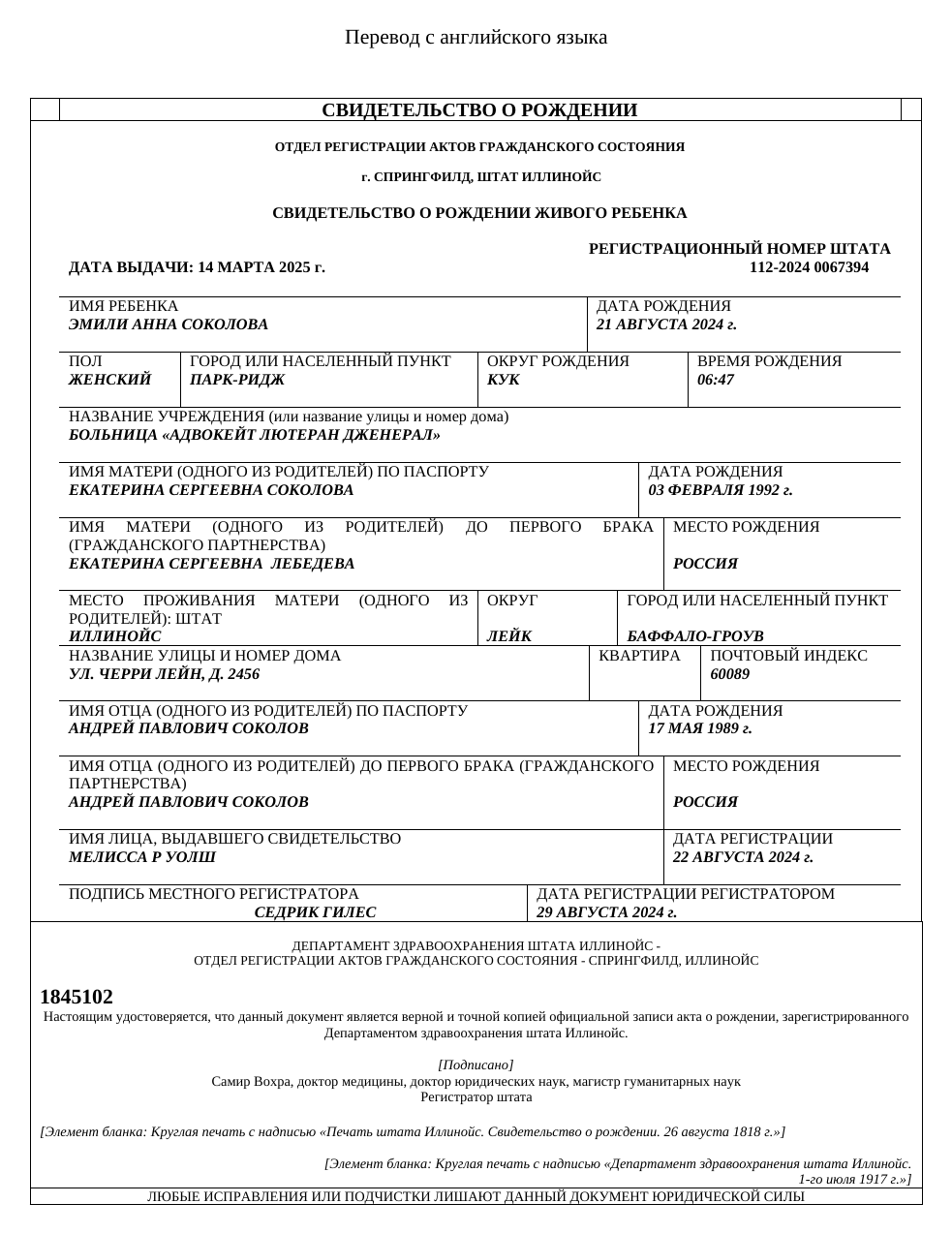
Illinois Birth Certificate in Russian
Prepared for a child's Russian citizenship application: the required page header, every seal described in brackets, handwritten signatures rendered as [Подписано], addresses transliterated.
We translate U.S. documents into Russian for use in Russia: birth, marriage and divorce certificates, apostilles, court orders, powers of attorney and official letters. Every translation is formatted to the requirements of the Russian Embassy and Consulates in the United States, so the consul can certify it without sending it back for corrections. Since 2007.
Every document is quoted individually.
For Russian government offices, consulates, banks, courts and notaries.
Most of our orders come from California, Texas, Illinois and Washington State, but we serve all 50 states remotely. Эта страница есть и по-русски.
Real translations from our files. All personal data has been replaced — we never publish client documents.
Prepared for a child's Russian citizenship application: the required page header, every seal described in brackets, handwritten signatures rendered as [Подписано], addresses transliterated.
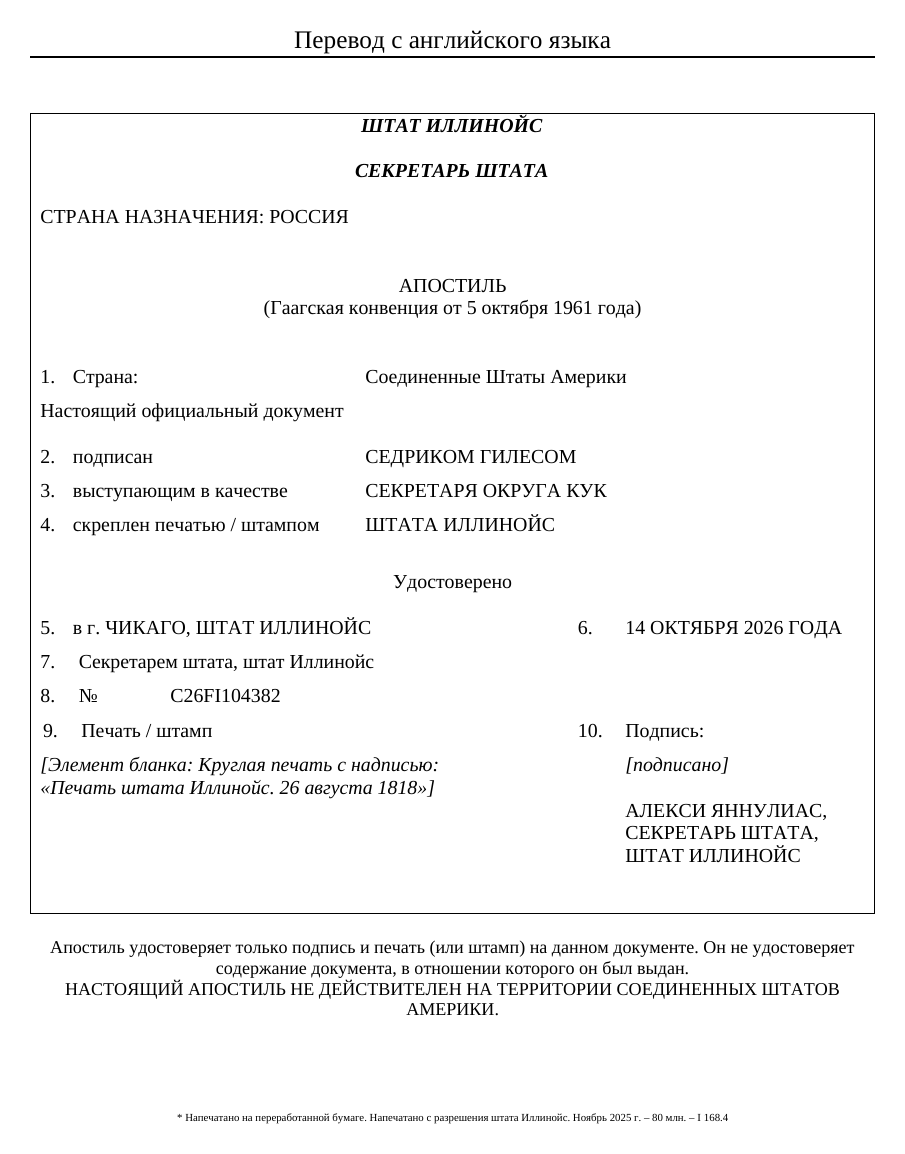
The apostille issued by the Secretary of State, translated into Russian. The apostille number stays untranslated and the state seal is described — exactly the way the consulates want it.
Russian authorities accept a U.S. document when it carries an apostille and comes with a Russian translation certified by a notary. Outside Russia, that notarial act is performed by Russian consular officers: the service is called certification of the accuracy of a translation (свидетельствование верности перевода).
The Embassy and the Consulates General do not translate documents. You come with a finished translation, and if it has defects — wrong date format, untranslated words, a translator's certification stamp — it is returned without being certified, which also stalls the application it was for, such as a child's citizenship. That is why they ask for the translation as an MS Word file: corrections must be quick to make. We deliver Word and PDF, and if the consulate asks for changes, we make them.
Get the apostille first: the Embassy in Washington only accepts documents with the apostille attached, and citizenship and passport applications require it everywhere. The reliable order is apostille → translation → consulate appointment.
Requirements change from time to time — check the official page of your consulate before booking an appointment.
Official pages (in Russian).
Russian consulates publish strict formatting rules for translations. Here is what we take care of:
Machine-translated texts are rejected outright. Your document is translated by a professional who works with these rules every week, then proofread.
We prepare both — tell us where the translation is going and we will format it accordingly.
When the translation goes to the Russian Embassy or a Consulate for certification, our own certification is not needed — the consul certifies the accuracy personally, and the consulates explicitly require translation agency stamps and certification notes to be removed from the text.
So for a consulate visit you receive a clean translation formatted to their rules, in MS Word and PDF.
When the translation will be shown to a border officer, a doctor, a bank or an employer rather than a consul, we issue a certified translation: on our letterhead, with a signed affidavit of translation accuracy — and notarized if you need it.
Typical cases: prescriptions and medication letters translated into Russian to show at the border when flying to Russia; a mother traveling with a child who has a different last name — a certified translation of the birth certificate proves the relationship; a parent's consent for a child's travel; documents for Russian banks, insurers or employers.
Email a photo or scan to [email protected] or send it by WhatsApp. Tell us which consulate the translation is for.
We review the document and reply with an exact price and turnaround — usually within 1–2 hours. The price depends on the document; you pay only after you agree.
The finished translation arrives by email as MS Word and PDF. Print it and bring it to your consulate appointment together with the original document.
The consul certifies the translation during your visit. If the consulate requests corrections, forward them to us — we will update the Word file.
Each document is quoted individually — the price depends on its length, the number of seals and any handwritten text. Send us a scan and we will reply with an exact price before you pay, usually within 1–2 hours.
No. The Russian consul certifies the accuracy of the translation personally, and consulates require translator certification stamps to be removed from the text. For banks, employers or courts we can provide a certified translation with a signed affidavit — notarized on request.
Yes. The Russian Embassy requires a translation of both the document and its apostille, so we always translate them together.
MS Word and PDF. The consulates themselves ask for the Word file so that any corrections can be made quickly. If your consulate returns the translation with comments, we will revise it.
Apostilles are issued by the Secretary of State of the state where the document was issued or notarized. We can help you arrange it — see our apostille service.
Contact us
Email or WhatsApp us a photo or scan of your document, or tell us about the interpreting job. We usually reply within 1–2 hours.
 WhatsApp